
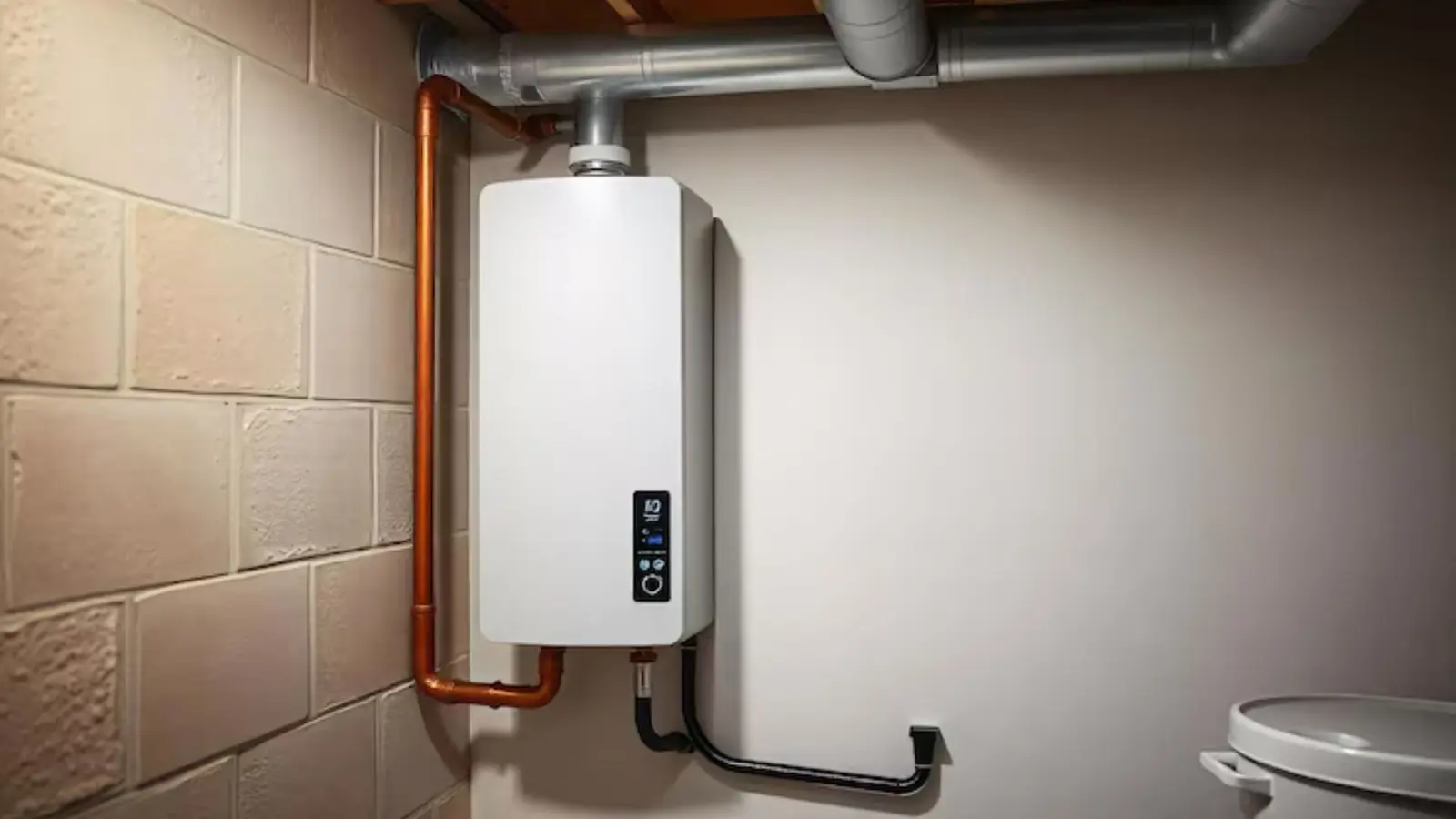
Tankless Water Heater Venting for Oakley, CA Homes
Tankless water heater venting in Oakley, CA decides whether a wall-hung unit runs safely or fills a garage with exhaust. The vent type has to match the unit, and the manual sets the rules.
Tankless water heater venting is the pipe path that carries combustion gases from a gas-fired on-demand heater to the outdoors. Because these units burn hot and fast, their exhaust is handled differently from a tank's flue, and the material, slope and termination point all come from the manufacturer's instructions.
This page covers the main vent types, how clearances and condensate work, and what to settle before a unit goes on the wall in an Oakley, CA home. It also notes where Air District and City questions come in.
Why a tankless unit cannot borrow an old tank flue
A conventional tank sends warm exhaust up a wide metal flue by natural draft. A tankless heater pushes much cooler, wetter exhaust with a fan, and that exhaust forms acidic condensate as it cools. Old galvanized or single-wall flue pipe is not built for it and can corrode from the inside.
That is the main reason a tankless conversion usually means new vent runs. If you are comparing models, the tankless water heater page covers sizing and what the unit does for your household, while this guide stays on the exhaust side.
Common vent materials and where each fits
The materials below are the ones manufacturers most often name. Only the types listed in your unit's manual are acceptable, so treat the table as a map and not a shopping list.
| Vent type | Typical use | Trade-off | Check in the manual |
|---|---|---|---|
| PVC or CPVC | Condensing units with cooler exhaust | Heat limits and approved listings vary by brand | Whether the maker allows it and which pipe class |
| Polypropylene | Condensing units with factory-matched kits | Needs the maker's own fittings and gaskets | Approved parts and joint style |
| Stainless steel | Higher-temperature exhaust and some retrofits | Costs more in parts and takes more care to seal | Wall type and support spacing |
| Existing metal flue | Sometimes reused with a liner | Condensate can eat through old pipe | Whether any reuse is permitted at all |
Have a wall picked for a tankless unit? Get the vent path, clearances and condensate drain checked before anything is mounted.
Call (855) 575-2890What the vent route has to get right
A direct vent unit draws combustion air from outside through a second pipe, which keeps the garage or closet air out of the burn. A room air unit pulls from the space, so that space needs enough openings.
A sidewall exit is shorter and easier to maintain. A roof exit suits an interior location, but it means more pipe, a roof penetration and flashing that has to stay watertight.
The manual gives distances from windows, doors, gas meters and property lines. Measure those before choosing the wall, because moving a termination later is expensive.
Condensing runs slope back toward the unit so liquid drains inside. Straps hold the pipe at the spacing the maker specifies, and sags trap water that causes error codes.
Every elbow counts as extra length. Exceed the maximum equivalent length and the unit can overheat or lock out.
Condensate: the part nobody plans for
Condensing tankless units produce a steady trickle of mildly acidic water. It has to run to a drain through a trap or a neutralizer, not onto the slab or into a planter bed. A floor drain, a laundry standpipe or a utility sink can serve, as long as the line slopes down and cannot freeze or kink.
Neutralizer cartridges need checking, since spent media lets acid through. Ask your installer where the drain will be before the unit is mounted, because discovering there is no drain nearby can force a design change.
Stand where the unit will hang and trace the vent to the outside wall. If the path crosses a joist, a window or a gas meter clearance, solve that on paper before buying.
Gas supply and the other half of the install
Venting is only one part of the job. A tankless heater often demands a larger gas line than the tank it replaces, plus a power outlet for the fan and a sediment trap on the gas. During or after a vent job, any gas odor sends everyone outside, followed by calls to 911 and PG&E at 1-800-743-5000.
The full scope of mounting, gas sizing and water connections is described on our water heater installation page. A homeowner can help by clearing the wall space and noting where the old flue and gas shutoff sit.
Tankless venting and the rules around Oakley
Venting choices for gas units here sit under the Bay Area Air Quality Management District. The zero-NOx start date of January 1, 2027 reaches new smaller units at the point of replacement and leaves existing equipment alone.
As of late October 2026 the Air District has drafted amendments that would delay compliance one year to January 2028 and add exemptions, with its Board scheduled to consider them on November 4, 2026. Look up the adopted date on the Air District site and ask your installer which models you can buy under it.
The City of Oakley's website does not list water heater work, so permit rules vary. The Building Division can tell you whether a vent change or a new gas line triggers one. Our service area page lists the nearby towns we cover, and homeowners in Brentwood should ask the City of Brentwood Building Division the same question.
Frequently asked questions
Usually not as it stands. Cooler, wetter exhaust can corrode an old flue, and many makers forbid reuse or allow it only with an approved liner.
Your unit's manual is the authority. A plumber can read it against what is already in your wall or roof.
Each model has a maximum equivalent length that counts straight pipe plus allowances for every elbow. The figure comes from the manual and differs by brand and pipe size.
Longer runs that exceed the limit can cause lockouts or poor combustion, so plan the shortest practical path.
Condensing models do. They create acidic water that must flow to a proper drain, often through a neutralizer.
Non-condensing models run hotter and use stainless venting, and they may produce little or no drain water, but the manual still decides.
Common causes are a blocked termination, a sagging pipe that holds water, a loose joint, or a run longer than allowed. Insects or snow can also block an exit.
Turn the unit off and look at the exterior termination. If the code returns, a plumber should test the vent and check combustion.
The zero-NOx rule applies to new gas units at the time of replacement, and the date is still being decided. As of late October 2026 the shift to January 2028 is a draft only.
Check baaqmd.gov before ordering, and ask the installer which models meet the standard that applies when your unit goes in.
Plan the vent, gas and drain together and get a clear price before work starts on your tankless install.
Call (855) 575-2890